Tuesday, October 17, 2017

Capitol staff, political consultants and lobbyists are signing a letter calling out the “pervasive” culture of sexual harassment and mistreatment that plagues their industry


From Weinstein to Sacramento

A state legislator who was groped by a male lobbyist weeks after she was sworn into office. A legislative staffer-turned-lobbyist who for years would wear only pantsuits to project a “business-only” air. A government affairs director who faced inappropriate advances from an associate in full view of male colleagues who seemed oblivious as it happened. As Hollywood takes a difficult look at itself amid the spiraling Harvey Weinstein sexual misconduct scandal, the women of California politics are publicly declaring: Us too. More than 140 women — including legislators, Capitol staff, political consultants and lobbyists —are signing a letter calling out the “pervasive” culture of sexual harassment and mistreatment that plagues their industry.

Thursday, October 12, 2017

You Have to Do Something.' Meet the 27-Year-Old Woman Teaching Millennials How to Run For Office

Charlotte Alter
Updated: Oct 11, 2017 9:04 AM ET | Originally published: Oct 10, 2017

Election Night was rough for Amanda Litman. As email director for Hillary Clinton's campaign, she remembers hearing senior staff reassure the team that their Midwestern firewall would hold, then watching Michigan, Wisconsin and Pennsylvania slowly turn red. She remembers Clinton campaign chairman John Podesta telling staff that they would fight until every vote is counted, then getting an alert that Clinton had called Trump to concede. The whole evening was a "nightmare," Litman says.

A few days later, something lifted Litman out of her funk: an old friend sent her a Facebook message, saying she was considering running for Chicago's city council to fix the city's failing schools. "She was like, 'Who do I ask for help?'" Litman recalls. "I didn't have an answer." The Cook County Democratic Party likely wouldn't invest in a rookie candidate. National political organizations wouldn't care. Organizations like Emily's List, which support progressive women running for office, typically don't invest in candidates running low-level local races.
Litman, 27, saw an opportunity. She began asking political friends whether any organizations supported young people who wanted to run for local office. "If it doesn't exist, it must be hard," she reasoned. She connected with Ross Morales Rocketto, a political operative married to one of Litman's friends from the Clinton campaign, who had been toying with a similar idea for years. Together, Litman and Rocketto built Run For Something, an organization dedicated to funding and supporting progressive millennial candidates running for local office.
The new group launched on Inauguration Day. During its first week, 100 potential candidates reached out. Over the next nine months, that number has swelled to nearly 11,000 young first-time candidates. (The group provides support to about 75% of candidates who ask.) So far Run For Something has raised some $400,000 from roughly 5,000 donors, including Clinton's Onward Together PAC. It has partnered with the Democratic Legislative Campaign Committee to try to turn state legislatures blue. And on Oct. 2, Litman published a book, Run For Something, essentially a how-to manual for young people to run for local office.
Run For Something is just one of several new political organizations that have cropped up since Trump's election to help advance progressive politics outside Democratic party structures. Sister District , Swing Left and Flippable direct volunteers and resources towards progressive candidates in down-ballot races. Indivisible has harnessed activist outrage to pressure members of Congress to resist Trump's agenda (thousands of Indivisible members staged protested ACA repeal at town halls across the country, which contributed to the bill's first failure in the House.) But so far, Run For Something is the only new group that is explicitly and exclusively focused on building a new progressive bench of young political talent.
Litman hopes the assistance her organization provides will help young women and minorities, who are often more wary of running, take the plunge into politics. "When I talk to old white male donors, they say ‘I’ve thought about running for Governor or Congress,'" she says. "I’m like, ‘Of course you have. You know who hasn’t? The young Latina woman who should.'"
While early funding can be critical in local elections, Run For Something isn't just about cash. It's about providing a much-needed support system for young candidates to swap tips about everything from how to canvass to how to communicate. The group has an active Slack channel with dozens of private conversations where first-time campaigners can compare notes and receive guidance from more experienced operatives.
"A lot of those lessons I probably would have learned, but it would have been the hard way, through messing things up ," says Kellen Squire, a 32-year old emergency-department nurse and father of three who is running for the Virginia House of Delegates. Squire, who lives near Charlottesville and works in a hospital that treated victims of the Charlottesville violence in August, says guidance from Run for Something helped him at the "nascent stage," when many campaigns struggle to get off the ground. Now he's raised about $70,000 through mostly small donations, and says he has a real shot to oust the Republican incumbent he's challenging. "It’s like the UVA football team going up against Alabama," Squire says. "You can win if you play right and you don’t make too many mistakes."
Garlin Gilchrist II is running to unseat a 3-term incumbent in the race for Detroit City Clerk this year. Gilchrist, who worked on the Obama campaign, is a voting-rights activist who wants to bring better management to the city's troubled election process. But running for office while raising 4-year old twins is challenging, and Gilchrist, 35, says he leans on the Run For Something network to help him figure out how to balancing canvassing with childcare.
"Having a national organization saying that these races matter locally, and specifically this race matters in Detroit, and this is the guy we support, that’s really helpful for my campaign," he says.
Most first-time candidates for office lose. But that doesn't dissuade Litman. She cites Bernie Sanders and Hillary Clinton as examples of political hopefuls who have lost elections but still made a contribution to democracy. And with the Democratic Party still reeling over Trump's election, she thinks it's time to empower a new generation of candidates to step in.


http://time.com/4974562/amanda-litman-run-for-something/

Public Speaking 101 on October 27


We have two great events that we hope you'll join us at! Register here.  If you prefer to send a check, print and send with this form.  Sponsorships are also available! Help us elect women by sponsoring this event.

#ICYMI (In Case You Missed It)

  • CONGRATULATIONS TO ENDORSED CANDIDATE WENDY CARRILLO for advancing to the AD51 special election runoff! Assembly District 51 seat was vacated by Jimmy Gomez when he was elected to Congress.  Wendy is a community advocate, journalist and radio host, and labor organizer who is a strong voice for economic justice, immigrants’ rights, and women’s rights.  She was supported by NWPC-CA in the Congressional race, and her strong showing has made her a leading candidate for the Assembly seat.  There were a total of 13 candidates and Wendy Carrillo made it into the #1 spot -- but its not over yet! There's a runoff on December 5th.  Get involved NOW. 

NWPC-CA Endorsement Activity Underway

Although the 2018 Primary and General Elections are still months away, candidate activity is building rapidly, and NWPC-CA has already issued the first of what we anticipate to be many candidate endorsements in an election where women are really showing up!
Early this year, NWPC-CA endorsed former State Superintendent of Public Instruction Delaine Eastin for Governor of California (see article below).  More recently, the Board has acted to endorse Board of Equalization member Fiona Ma for State Treasurer, and to endorse Betty Yee for re-election as State Controller.   NWPC-CA also endorsed Christy Smith for election in AD 38, a race she narrowly lost in 2016 and where her support has continued to build.  All were endorsed by NWPC-CA in previous races and all well deserve your enthusiastic support, volunteer effort, and donations.  NWPC-CA is in the process of identifying and contacting women who already have or may soon announce campaigns for statewide office, the state Legislature, and Congress.  In addition to supporting NWPC-CA’s bottom line issues, candidates seeking our endorsement must demonstrate they are qualified for the position they seek and credible as candidates, with a path to victory even if they are not front-runners.  If you are interested in helping with the process, let your local officers know and/or contact Karriann Farrell-Hinds, the state Vice President for Political Action, at VPPAC@nwpcca.org.   
Check the state website link for candidates at http://nwpcca.org/candidates-2/.  You can learn more about the endorsement process, and you can also get information on endorsed candidates.  

A message from NWPC California president, Karen Humphrey: 

HOW MUCH DO YOU REALLY WANT TO SEE A WOMAN GOVERNOR IN CALIFORNIA?
If the answer to the above question is “a lot!!!”, I’m asking you to get involved directly in the campaign to elect Delaine Eastin as much and as soon as you can.
Here’s the context:  California has never had a woman governor, and has not had even a progressive woman candidate for Governor since 1990, when Kathleen Brown ran unsuccessfully.   Since that time,  Delaine Eastin was hard at work: serving on her Union City Council; serving in the California Assembly, where she headed the Education Committee; and then serving as California’s State Superintendent of Public Instruction for eight years between 1995 and 2003.  Since leaving office, Delaine has held major national leadership positions, taught at Mills College, and thrown herself into promoting California education and progressive, pro-choice women as Jane Q. Citizen.   
Nobody else running for Governor in 2018 has the combined public service experience (city government, legislature, AND statewide office) that Delaine does.  Nobody else running for Governor has the record of accomplishment in both education and other major public policy issues that she does.  Nobody else running for Governor has the power to inspire Californians as she can, as one of the most eloquent speakers in public life.  And significantly, nobody else running for Governor is a progressive, pro-choice woman—which is long overdue in our 167-year-old state!
Given that history, her qualifications, and her lifelong support for women’s rights and the advancement of women into public leadership, it was easy for NWPC California to endorse Delaine for Governor earlier this year.  We knew this was the candidate who can break the “golden glass ceiling” in the Governor’s office and provide visionary, energetic leadership for ALL the people of California.
Here’s the thing, though.  Delaine can only win if we put our money, our shoe leather, our voices, and our commitment into creating the greatest grassroots campaign in California history to elect her.  She will not have more money than the well-funded men she’s running against, nor the adoration of single-issue crowds, or the “moth to a flame” attraction of celebrity candidates.  What she has is the grit, the determination, and the track record of winning elections she wasn’t supposed to win.  She has the brains, the deep understanding of issues, the energy, and most of all, the heart to help California and all the people who live here reach their full potential.
SO—if you aren’t convinced by now that you need to get on board in a tangible way, please reread this article.  Or call me at 916-730-3419 or email me at president@nwpcca.org and let me see if I can persuade you.  You aren’t obligated to work for Delaine just because you’re part of NWPC.  But if you care about our mission, you will not pass up the chance to help elect the most viable candidate for California’s first woman governor in years, and likely our last chance for at least eight years to come.  
If you are convinced, please go to www.delaineforgovernor.com and sign up as a volunteer and as a donor (best idea—give a set amount each month automatically).  Delaine needs us and she needs us now—not next month or next year.  The June primary is only eight months away.  If Delaine is one of the top two, she absolutely will win.  We have to help get her there.   
This isn’t about NWPC or even about being politically active women.  This is about the future of our state at a critical time in the future of this country and this is our last chance for almost a decade to put a woman at the head of California state government.   Please don’t hesitate—get on board now!
Become Member

Tuesday, October 3, 2017

Women and Girls are Key to National Security

There is a growing body of knowledge about the nexus between gender equality, economic growth, and political stability. Studies by government agencies, multilateral institutions, and private sector entities have confirmed that investing in gender equity, often in the form of funding for programs and initiatives that focus on empowering women and girls, yields broad dividends for economies and societies around the world.
It is unclear whether and how the Trump administration will prioritize funding for gender-specific programs which have received varying investments and attention in prior administrations; however, the empowerment of women and girls around the world must remain a central and core pillar of our nation’s national security agenda.
There is compelling evidence that a link exists between a society’s treatment of women and its overall security and prosperity. Gender equality has, in the past, been viewed in the traditional national security paradigm as a zero-sum investment, and demonstrated benefits resulting from gender equality were considered as merely ancillary, as opposed to directly associated with a society’s strategic national security approach. However, strong evidence demonstrates that a more prosperous society and a more stable world results when women and girls are empowered; have access to services, education, and capital; and are otherwise afforded opportunities to fully participate in their societies.
Whether we reference a McKinsey & Company report revealing the economic implications of gender equity and how women’s equality can add $12 trillion to the global economy; the Organization of Economic Coordination and Development’s report about gender equality’s impact on sustainable development; or the United Nations’ research linking war and conflict with women’s rights that resulted in UN Resolution 1325 on Women, Peace, and Security, all signs point to the fact that, as a matter of strategy and returns, investments in gender equality and women’s rights are not making dents in a vacuum and are worth every dollar spent.
As a matter of strategy and returns, investments in gender equality and women’s rights are not making dents in a vacuum and are worth every dollar spent.
These results, in part, informed the Obama administration’s approach to its national security strategy. The State Department and other agencies during the Obama years integrated international women’s issues into the U.S. government’s national security framework. The advancement of women and girls and gender equality were not considered separate and apart from decisions about how the administration was going to combat ISIL, the threat of climate change, and other foreign policy priorities at that time. Indeed, tackling extreme poverty and violent extremism in the form of Boko Haram or ISIL, reducing child and maternal health mortality rates, and investing in programs that create stronger economies and reducing the incidents of conflict were viewed as a matter of national security.
The government based these decisions on a common understanding that programs addressing gender equality were essential to chip away at the root of many global security challenges of the 21st century. Former President Obama stated last year at the United State of Women Summit that societies that oppress half the population will not reach their full potential. "This is a national security issue," he said in his remarks. "As commander-in-chief, I’ve seen how the ideology that leads Boko Haram to kidnap schoolgirls and leads ISIL to enslave and rape women is the same ideology that leads to instability, violence, and terrorism."
This approach was reflected in various Obama administration programs, strategic documents, and policy initiatives, including the 2010 legislatively mandated National Security Strategy, the Presidential Policy Directive on Global Development, and a Presidential Memorandum which positioned gender equality and the advancement of women and girls as "vital to achieving our overall foreign policy objectives."
The White House Council on Women and Girls, along with other federal agencies, was instrumental in ensuring that gender issues were mainstreamed throughout the policy-making process across the federal government. Institutionalizing and integrating these women-focused efforts as part of the national security structure during the administration were key to elevating these issues beyond what has traditionally been considered "soft" or "special interest" projects, and ensuring effective interagency coordination and implementation of these efforts to advance women and girls’ issues globally.
The advancement of women and girls and gender equality were not considered separate and apart from decisions about how the Obama administration was going to combat ISIL, the threat of climate change, and other foreign policy priorities at that time. They were viewed as a matter of national security.
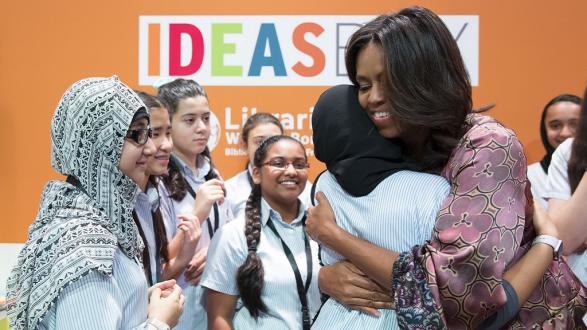
In addition to efforts to embed these programs and structures in the governmental DNA, gender equality initiatives were a clear priority for U.S. Secretary of State Hillary Clinton, who has long-championed these views; former U.S. Ambassador to the UN Samantha Power; First Lady Michelle Obama, who launched the "Let Girls Learn" girls’ education program; and former Senior Advisor to the President and Chair of the White House Council on Women and Girls Valerie Jarrett. Moreover, countless administration officials across the government traveled and organized visits for U.S. officials to meet with women all over the world to discuss the challenges and opportunities they encountered in their own societies.
While it may be tempting for some to categorize these programmatic and structural efforts as falling in the "nice to do" box because they were the "right thing to do" (which they were), they were part of a broader strategic approach to national security.
Of course, the Obama administration was not the first to prioritize these issues, and none of the aforementioned efforts operating alone will suffice to realize a fully comprehensive and effective strategy to integrate international women’s issues into the national security infrastructure. Taken together, however, these efforts can establish a durable structural and policy foundation that can become part of the fabric of our development and diplomatic agenda.
Seven months into the current administration, much remains unknown about whether global women’s issues will remain a high priority. Secretary of State Rex Tillerson stated in his confirmation hearing that "when you empower women, you change the future of the country because you change the cycle of that family…These are extraordinarily powerful programs and an important part of foreign aid." On the other hand, the Office of Global Women’s Issues currently is without a director or ambassador and the 2018 federal budget reportedly plans to eliminate funding for the office.
Integrating women’s issues is not only a moral imperative, but an economic, political, and security one. What’s more, our collective global security demands it.
To be sure, the primacy of global women’s issues has been a challenge for many administrations and much work remains to be done to thwart the tendency to sideline these issues and position them on the outside of a strategic national security focus. Even when there are shared views and general agreement about an approach, the process may not be a smooth one. After all, it takes time for the implementation of programs and initiatives to take root, and the process is most often not a linear one through successive U.S. presidential administrations.
Admittedly, it is too soon to draw any firm conclusions regarding the current administration’s views on the relationship between gender equity and national security. At this time, however, there remains an opportunity for the United States to lead on this issue along with our allies (e.g. Germany) who are making great gains in this area, and to complement the work that is being done in the multilateral, NGO, and private sector arenas.
As has been noted for many years, integrating women’s issues is not only a moral imperative, but an economic, political, and security one. What’s more, our collective global security demands it.
_______________________
Karen Richardson is a Pacific Council member and served as a deputy assistant secretary of the Bureau of Public Affairs at the U.S. State Department and as a White House advisor.
The views and opinions expressed here are those of the author and do not necessarily reflect the official policy or position of the Pacific Council.

LEADership Academy on October 19, 2017


Thursday, October 19, 2017 at AT&T in El Segundo
A great line-up of women leaders participating including Mona Pasquil, Appointments Secretary for Governor Brown; Fiona Ma, Member, State Board of Equalization & 2018 Candidate for State Treasurer; Jan Perry, former Councilwoman, City of Los Angeles; Heather Repenning, Vice President, City of Los Angeles Board of Public Works and Suzanne Fuentes, Mayor of El Segundo (partial list).

Topics for the day long training include:  
•             Getting Done – Women Leading in Business, Community and Life
•             All Politics is Local
•             Diversity, Inclusion and the Future for Women in STEM
•             How to get appointed to a state board or commission

Return To Homepage